
The Sursus
The wine-dark sea of A Philosophy of Air

Hi! I’m Marc and I’m writing A Philosophy of Air, a naturalistic fantasy novel about airships, allies, enemies and the tensions between reason and superstition. In this series of posts, I’m revealing the enormous, complex world of my novel, largely in the hope that you’ll become interested and maybe even help me make it better.
In a recent post, I described the various lands of the Archipelago. Today, I want to dig into the space in-between, the cloud sea called the sursus.
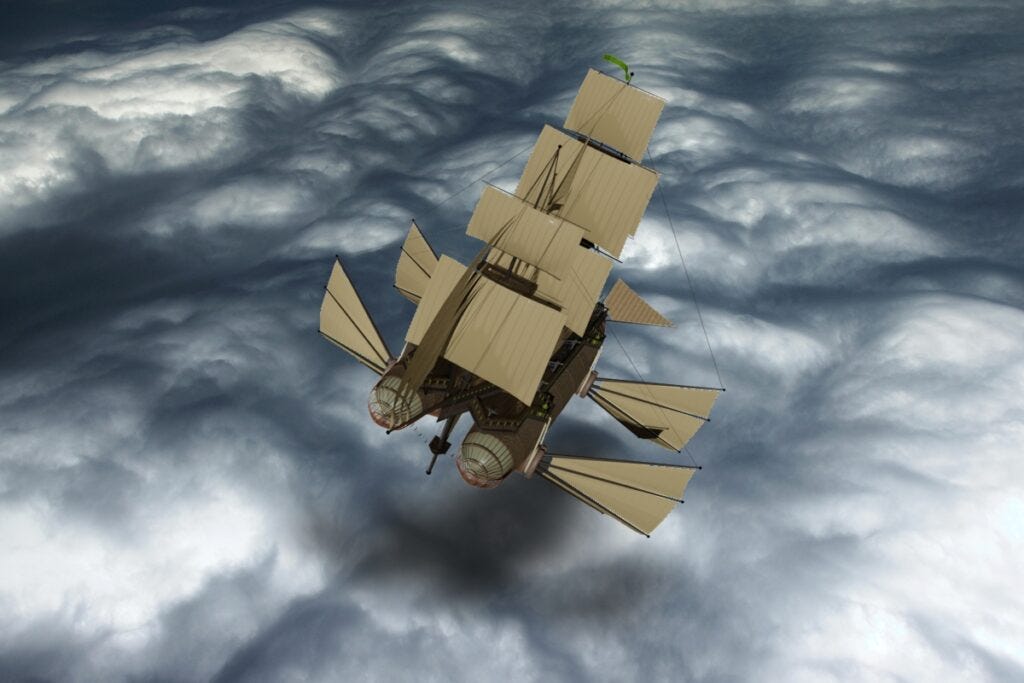
The sursus is a key element of my world for several reasons: it motivates a lot of what this world is about, necessitating the use of airships; it’s the source of the gas that makes airships themselves possible (which we’ll discuss in the next post); it’s a grey, foreboding presence, a constant physical threat and therefore the source of innumerable superstitions; and it’s a powerful symbol within the story for isolation, fear, and death.
What exactly is the sursus?
My characters know only what they can see: a milky, viscous ocean of acidic clouds which will burn, blind, and kill anyone who gets too close.
But the world of the Archipelago has just begun a period akin to our Renaissance; some are just beginning to think in scientific terms, to analyze their environment with something more than religious or superstitious intent. Recall how Galileo was branded a heretic for suggesting that the Sun, not the Earth, lay at the center of the universe.
Such natural philosophers are beginning to question the true nature of the sursus. What is it composed of? Where did it come from? Has it always been there?
The sursus maintains a fairly steady altitude below the islands of the Archipelago, but it has tides which rise and fall, and weather can affect it, sometimes bringing the acidic clouds into contact with people and towns. That makes it a constant threat, especially in bad weather.
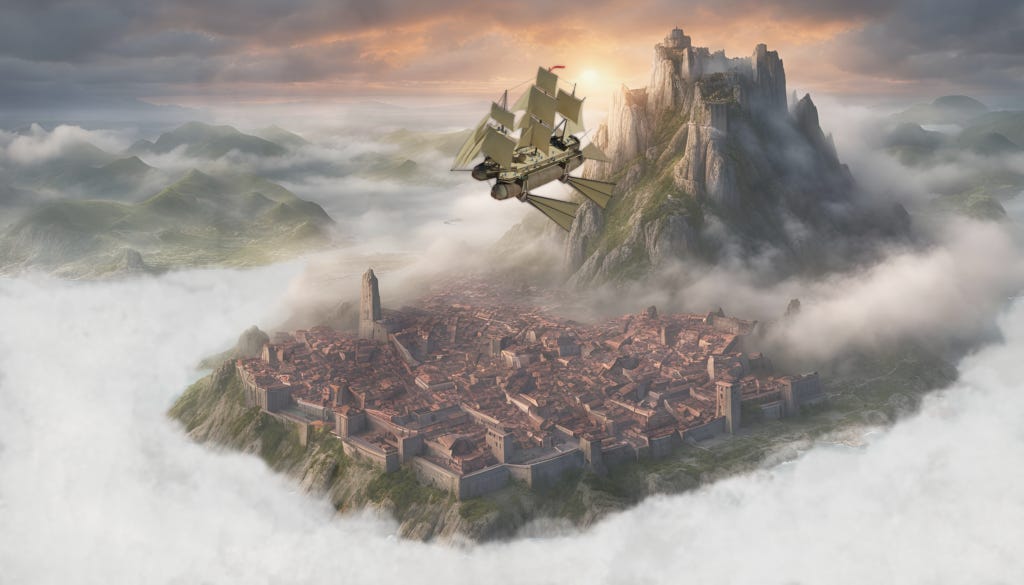
That which threatens may also nourish
But this same dangerous presence likewise motivates the people of the Archipelago. In fact, according to legend, in one instance it motivated a woman to murder her abusive husband, an attempt which backfired spectacularly, indirectly leading to the invention of airships.
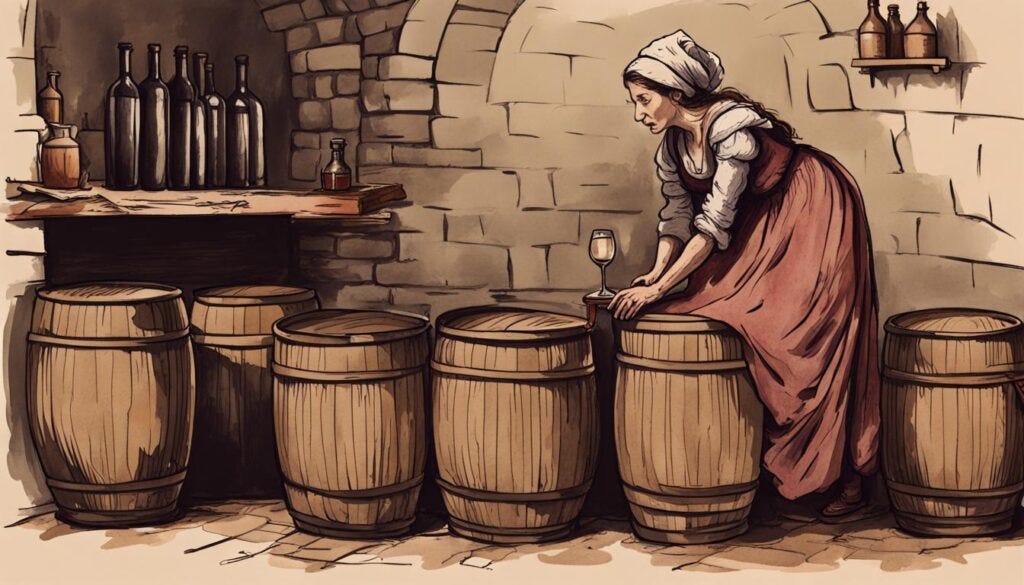
The story goes that in some long-forgotten past, on the island of Sunrise, a woman tried to poison her abusive husband by exposing his wine — which he distilled into brandy — to the sursus. But instead of poisoning him, she inadvertently invented a new drink called sureau (“sour water” or “sursus water”). Distillation rendered the liquid drinkable, the poisonous gas discarded harmlessly into the air.
A distiller centuries later discovered that those noxious fumes yielded a gas with remarkable lifting capacity. This led to airborne vessels, first as a novelty, then as a tool, and eventually as a means to explore the world beyond the horizon. This sursic gas is arguably the most important commodity in our world, and every nation necessarily produces sureau, if only to harvest the gaseous byproduct.
The sursus as symbol
I’ll always be a little cagey when discussing symbolism, partly because I don’t want to bore you and partly because I think it’s more interesting for each reader to discover this sort of thing either for themselves or in discussion. That said, it’s not too much to suggest that the sursus represents the magnitude of all that our characters fear about the world they’re in.
Humans are small and the world is vast. We lean on our fears and prejudices and superstitions. In A Philosophy of Air, the sursus expresses a literal embodiment of those fears, a source of peril, even death, always in sight and eternally stalking our characters.
“Fear,” as we know from Dune, “is the mind killer.” It incapacitates not only immediate thought and action; often it incapacitates a willingness to pursue thought. Look at today’s world. Think about those who enforce fear of some “other” upon us. It’s very easy to allow that fear to cloud our judgement, to lean on our biases instead of exerting our intellect to arrive at the truth, especially when that truth doesn’t support what we want to be true.
The sursus as a source for superstition
And in fact this brings us to one last practical ramification of the sursus: since people find comfort in explaining their fears, in compartmentalizing them, the sursus has become a repository of many of the Archipelago’s superstitious beliefs. Do this winter’s storms seem worse than usual? Blame a creature stirring up the sursus. Your crops failed to grow; one may find it convenient to blame a weather witch. Don’t sail too close to the sursus...a jealous god may swallow your ship whole!
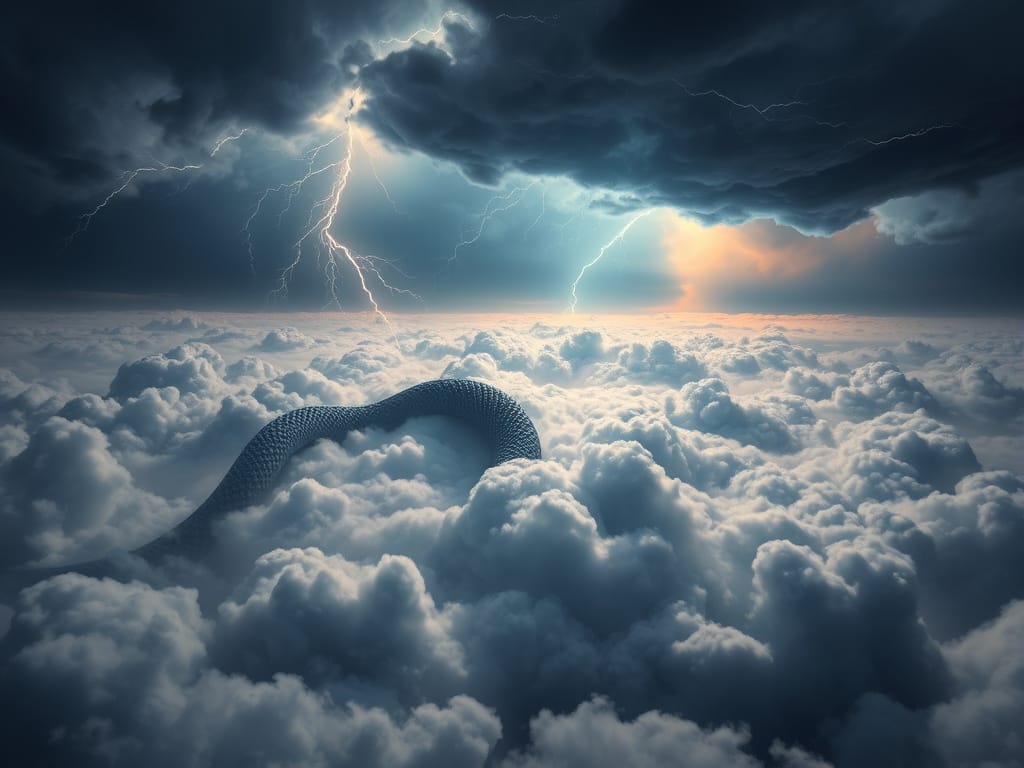
I’ll delve into many of these superstitions in another post, but you can imagine a range of imagined fantastic horrors lurking below or with the power to control the sursus, including dragons, weather witches, gods and goddesses, mythic characters, and the like.
It’s all part of the danger — real, imagined, or manufactured — lurking within the murky depths of the Archipelago.
If you dig my world-building, take a look at some of my prior posts where I discuss the Archipelago itself, its languages, and more.
And please consider subscribing to this blog. It’s free and helps me build an audience for A Philosophy of Air. You can also follow me on my personal blog.
I wondered why airships existed instead of normal ships in your world. I’m so glad you came up with such a creative idea. It opens up a lot of fun, sciency potential.
I love it. Can't wait to read more.